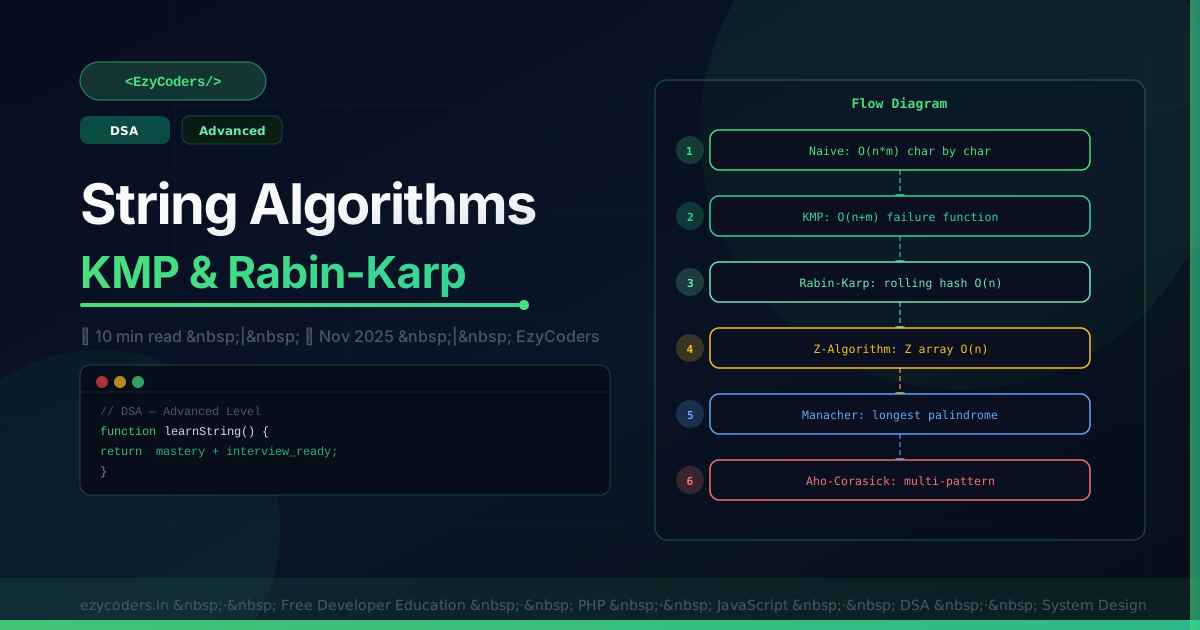
String Algorithms
Efficient string searching powers text editors, search engines, and bioinformatics. KMP improves naive O(n*m) to O(n+m).
def build_lps(pattern):
    m   = len(pattern)
    lps = [0] * m
    prev = i = 0
    while i < m:
        if i == 0: prev = 0
        if pattern[i] == pattern[prev]:
            prev += 1; lps[i] = prev; i += 1
        elif prev:
            prev = lps[prev-1]
        else:
            lps[i] = 0; i += 1
    return lps

def kmp_search(text, pattern):
    n, m = len(text), len(pattern)
    lps  = build_lps(pattern)
    matches = []
    i = j = 0
    while i < n:
        if text[i] == pattern[j]:
            i += 1; j += 1
        if j == m:
            matches.append(i - j)
            j = lps[j-1]
        elif i < n and text[i] != pattern[j]:
            if j: j = lps[j-1]
            else: i += 1
    return matches

print(kmp_search("AABAACAADAABAABA", "AABA"))  # [0, 9, 12]
Rabin-Karp Rolling Hash
def rabin_karp(text, pattern, q=101):
    n, m = len(text), len(pattern)
    d = 256
    h = pow(d, m-1, q)
    p_hash = t_hash = 0
    matches = []

    for i in range(m):
        p_hash = (d*p_hash + ord(pattern[i])) % q
        t_hash = (d*t_hash + ord(text[i])) % q

    for i in range(n-m+1):
        if p_hash == t_hash:
            if text[i:i+m] == pattern: matches.append(i)
        if i < n-m:
            t_hash = (d*(t_hash - ord(text[i])*h) + ord(text[i+m])) % q
            if t_hash < 0: t_hash += q
    return matches
Q: What makes KMP faster than naive?
Naive restarts from position 0 on each mismatch. KMP precomputes LPS (failure function) to know exactly how far back to go — the text pointer i never moves backward, guaranteeing O(n) traversal.












Comments (0)
No comments yet. Be the first!
Leave a Comment