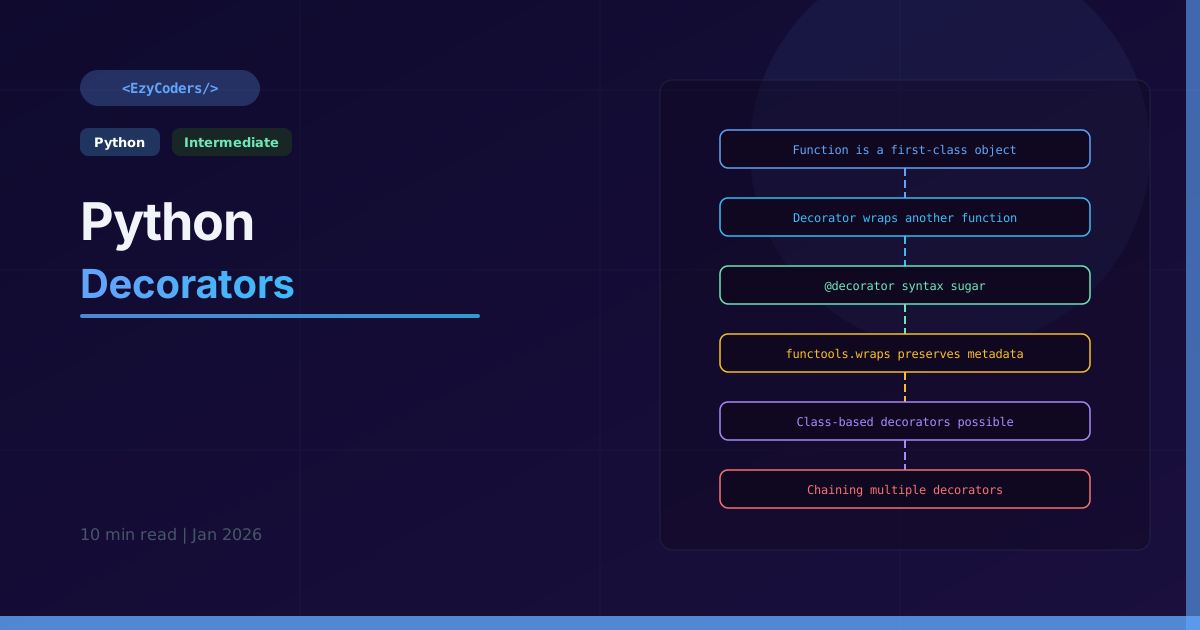
Python Decorators
Decorators are one of Python's most powerful features. They wrap a function to add behaviour without modifying its source code. Understanding them is essential for Python interviews and for writing clean, reusable code.
Functions Are First-Class Objects
def greet():
    return "Hello!"

# Functions can be assigned to variables
say_hi = greet
print(say_hi())  # Hello!

# Functions can be passed as arguments
def run(func):
    return func()

print(run(greet))  # Hello!

# Functions can be returned from other functions
def make_greeter(name):
    def inner():
        return f"Hello, {name}!"
    return inner  # return function, not its result

hello_rahul = make_greeter("Rahul")
print(hello_rahul())  # Hello, Rahul!
Your First Decorator
import time
from functools import wraps

def timer(func):
    @wraps(func)  # preserves original function metadata
    def wrapper(*args, **kwargs):
        start  = time.perf_counter()
        result = func(*args, **kwargs)  # call original
        end    = time.perf_counter()
        print(f"{func.__name__} took {end-start:.4f}s")
        return result
    return wrapper

@timer  # equivalent to: slow_function = timer(slow_function)
def slow_function():
    time.sleep(0.1)
    return "done"

slow_function()  # slow_function took 0.1001s
Decorator with Arguments
def retry(max_attempts=3, exceptions=(Exception,)):
    def decorator(func):
        @wraps(func)
        def wrapper(*args, **kwargs):
            for attempt in range(1, max_attempts + 1):
                try:
                    return func(*args, **kwargs)
                except exceptions as e:
                    print(f"Attempt {attempt} failed: {e}")
                    if attempt == max_attempts:
                        raise
        return wrapper
    return decorator

@retry(max_attempts=3, exceptions=(ConnectionError,))
def fetch_data(url):
    # simulated network call
    raise ConnectionError("Network down")

# fetch_data("https://api.example.com")
# Attempt 1 failed: Network down
# Attempt 2 failed: Network down
# Attempt 3 failed: Network down
# raises ConnectionError
Practical Decorators
from functools import wraps

# 1. Login Required
def login_required(func):
    @wraps(func)
    def wrapper(request, *args, **kwargs):
        if not request.get('user'):
            return {'error': 'Login required', 'code': 401}
        return func(request, *args, **kwargs)
    return wrapper

# 2. Cache / Memoize
def memoize(func):
    cache = {}
    @wraps(func)
    def wrapper(*args):
        if args not in cache:
            cache[args] = func(*args)
        return cache[args]
    return wrapper

@memoize
def fib(n):
    if n <= 1: return n
    return fib(n-1) + fib(n-2)

print(fib(50))  # instant

# 3. Rate Limiter
import time
from collections import defaultdict

def rate_limit(calls_per_second=1):
    last_called = defaultdict(float)
    def decorator(func):
        @wraps(func)
        def wrapper(*args, **kwargs):
            elapsed = time.time() - last_called[func.__name__]
            if elapsed < 1.0 / calls_per_second:
                time.sleep(1.0 / calls_per_second - elapsed)
            last_called[func.__name__] = time.time()
            return func(*args, **kwargs)
        return wrapper
    return decorator

# 4. Type Validation
def validate_types(**type_map):
    def decorator(func):
        @wraps(func)
        def wrapper(**kwargs):
            for param, expected in type_map.items():
                if param in kwargs and not isinstance(kwargs[param], expected):
                    raise TypeError(f"{param} must be {expected.__name__}")
            return func(**kwargs)
        return wrapper
    return decorator

@validate_types(name=str, age=int)
def create_user(name, age):
    return {'name': name, 'age': age}

create_user(name='Rahul', age=25)   # OK
create_user(name='Rahul', age='25') # TypeError: age must be int
Class-Based Decorators
class CountCalls:
    def __init__(self, func):
        self.func  = func
        self.count = 0
        wraps(func)(self)  # copy metadata

    def __call__(self, *args, **kwargs):
        self.count += 1
        print(f"{self.func.__name__} called {self.count} times")
        return self.func(*args, **kwargs)

@CountCalls
def process():
    return "processed"

process()  # process called 1 times
process()  # process called 2 times
print(process.count)  # 3
Q: Why use @wraps in decorators?
Without @wraps, the wrapped function loses its __name__, __doc__, and other metadata. If you call help() or inspect the function, you see the wrapper's metadata instead. @wraps(func) copies the original function's attributes to the wrapper.
Q: What is the execution order of stacked decorators?
Decorators apply bottom-up at definition time but execute top-down at call time. @a @b def f(): pass is equivalent to f = a(b(f)). When called, a's wrapper runs first, then b's wrapper, then the original function.










Comments (0)
No comments yet. Be the first!
Leave a Comment