Hash Tables
Hash tables provide O(1) average-case insertion, deletion, and lookup. They are the most used data structure after arrays — Python dicts, JavaScript objects, and PHP arrays are all hash tables under the hood.
How Hash Tables Work
class SimpleHashTable:
    def __init__(self, size=10):
        self.size    = size
        self.buckets = [[] for _ in range(size)]  # list of buckets

    def _hash(self, key: str) -> int:
        # Simple hash function: sum of ASCII values mod table size
        return sum(ord(c) for c in key) % self.size

    def set(self, key: str, value) -> None:
        idx    = self._hash(key)
        bucket = self.buckets[idx]
        for i, (k, v) in enumerate(bucket):
            if k == key:
                bucket[i] = (key, value)  # update existing
                return
        bucket.append((key, value))        # insert new

    def get(self, key: str):
        idx = self._hash(key)
        for k, v in self.buckets[idx]:
            if k == key:
                return v
        raise KeyError(key)

    def delete(self, key: str) -> None:
        idx = self._hash(key)
        self.buckets[idx] = [(k,v) for k,v in self.buckets[idx] if k != key]

ht = SimpleHashTable()
ht.set('name', 'Rahul')
ht.set('age',  25)
print(ht.get('name'))  # Rahul
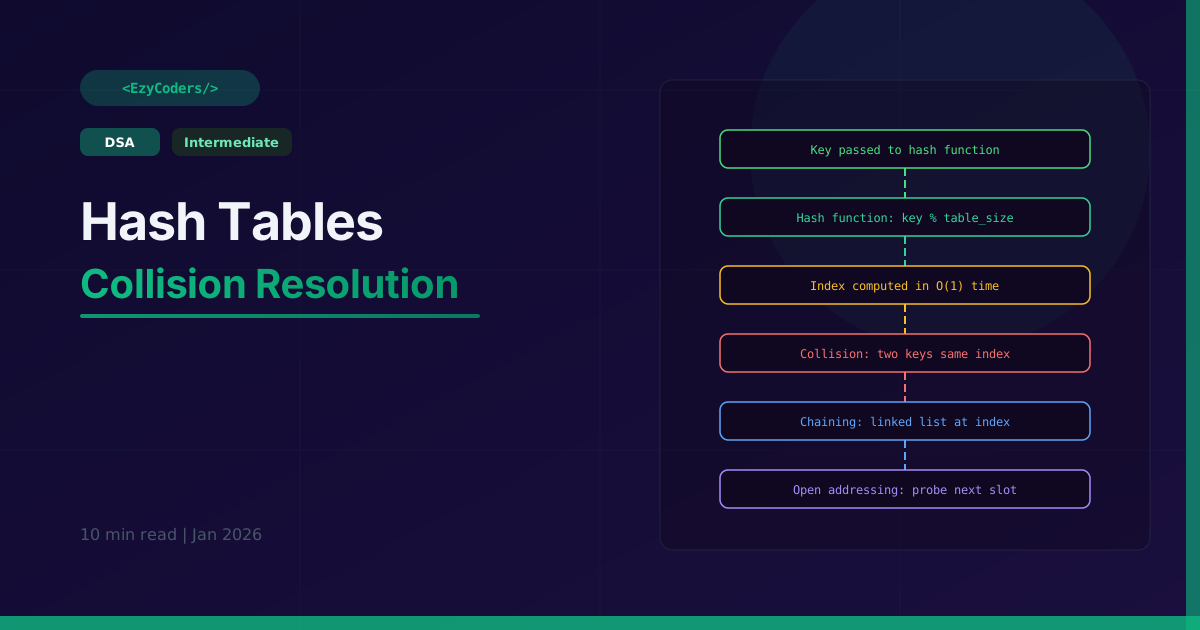
Collision Resolution — Chaining vs Open Addressing
# Chaining (used above): store list at each bucket index
# Pro: simple, handles many collisions
# Con: cache-unfriendly (linked list traversal)

# Open Addressing — Linear Probing
class LinearProbing:
    def __init__(self, size=10):
        self.size    = size
        self.keys    = [None] * size
        self.values  = [None] * size
        self.deleted = object()  # sentinel

    def _hash(self, key):
        return hash(key) % self.size

    def set(self, key, value):
        idx = self._hash(key)
        while self.keys[idx] is not None and self.keys[idx] != key:
            idx = (idx + 1) % self.size  # probe next slot
        self.keys[idx]   = key
        self.values[idx] = value

    def get(self, key):
        idx = self._hash(key)
        while self.keys[idx] is not None:
            if self.keys[idx] == key:
                return self.values[idx]
            idx = (idx + 1) % self.size
        raise KeyError(key)
Common Hash Table Interview Problems
# 1. Two Sum — O(n) using dict
def two_sum(nums, target):
    seen = {}
    for i, n in enumerate(nums):
        complement = target - n
        if complement in seen:
            return [seen[complement], i]
        seen[n] = i
    return []

print(two_sum([2,7,11,15], 9))  # [0, 1]

# 2. Group Anagrams
def group_anagrams(strs):
    groups = {}
    for s in strs:
        key = tuple(sorted(s))  # sort letters as key
        groups.setdefault(key, []).append(s)
    return list(groups.values())

print(group_anagrams(['eat','tea','tan','ate','nat','bat']))
# [['eat','tea','ate'], ['tan','nat'], ['bat']]

# 3. First Non-Repeating Character
def first_unique(s):
    count = {}
    for c in s: count[c] = count.get(c, 0) + 1
    for i, c in enumerate(s):
        if count[c] == 1: return i
    return -1

print(first_unique('aabbcde'))  # 4 (index of 'c')
Q: What is a hash collision and how is it handled?
A collision occurs when two different keys produce the same hash index. Chaining stores all colliding pairs in a linked list at that index. Open addressing finds the next empty slot by probing (linear, quadratic, or double hashing). Python uses open addressing with a form of pseudo-random probing.












Comments (0)
No comments yet. Be the first!
Leave a Comment