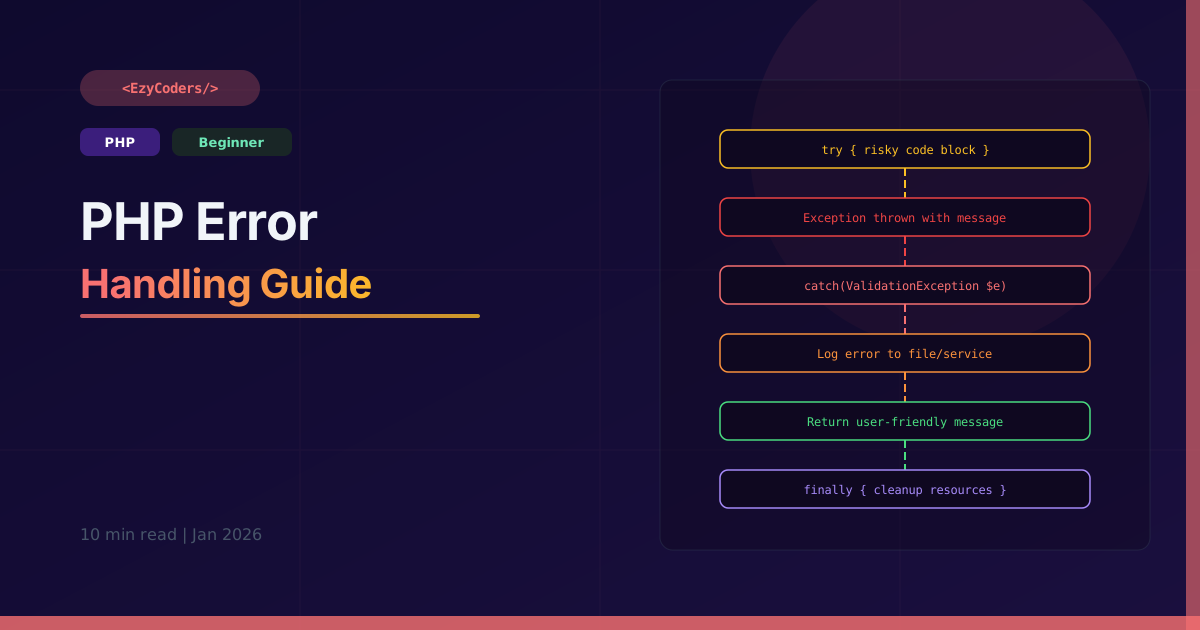
PHP Exception Handling
Proper exception handling separates production-ready PHP from hobby projects. Unhandled exceptions expose stack traces to users, hide bugs, and crash applications. Master try-catch-finally and custom exceptions.
Try-Catch-Finally Basics
<?php
function divide(int $a, int $b): float {
    if ($b === 0) throw new DivisionByZeroError("Cannot divide by zero");
    return $a / $b;
}

try {
    echo divide(10, 0);
} catch (DivisionByZeroError $e) {
    echo "Math error: " . $e->getMessage();
    echo " in " . $e->getFile() . ":" . $e->getLine();
} catch (TypeError $e) {
    echo "Type error: " . $e->getMessage();
} catch (\Throwable $e) {
    // Catches ALL errors and exceptions
    error_log($e->getMessage());
    echo "Something went wrong.";
} finally {
    // Always runs — close connections, release locks
    echo "Done.";
}
Custom Exception Hierarchy
<?php
class AppException extends \RuntimeException {}

class ValidationException extends AppException {
    public function __construct(private array $errors) {
        parent::__construct("Validation failed");
    }
    public function getErrors(): array { return $this->errors; }
}

class NotFoundException extends AppException {
    public function __construct(string $resource, int $id) {
        parent::__construct("$resource with ID $id not found", 404);
    }
}

class UnauthorizedException extends AppException {
    public function __construct(string $action = "perform this action") {
        parent::__construct("Not authorized to $action", 403);
    }
}

// Usage
function updatePost(int $id, array $data): void {
    if (!postExists($id)) throw new NotFoundException('Post', $id);
    if (!currentUserOwns($id)) throw new UnauthorizedException('edit this post');

    $errors = validatePostData($data);
    if ($errors) throw new ValidationException($errors);

    savePost($id, $data);
}

try {
    updatePost(42, ['title' => '']);
} catch (ValidationException $e) {
    foreach ($e->getErrors() as $field => $msg) echo "$field: $msg\n";
} catch (NotFoundException $e) {
    http_response_code(404);
    echo json_encode(['error' => $e->getMessage()]);
} catch (UnauthorizedException $e) {
    http_response_code(403);
    echo json_encode(['error' => $e->getMessage()]);
}
Global Exception Handler
<?php
set_exception_handler(function(\Throwable $e) {
    error_log(sprintf("[%s] %s\n%s:%d\n%s",
        date('Y-m-d H:i:s'), $e->getMessage(),
        $e->getFile(), $e->getLine(), $e->getTraceAsString()
    ));

    http_response_code($e->getCode() >= 400 ? $e->getCode() : 500);
    header('Content-Type: application/json');
    echo json_encode([
        'error' => $e instanceof AppException ? $e->getMessage() : 'Server error',
    ]);
});

// Convert PHP errors to exceptions
set_error_handler(function(int $sev, string $msg, string $file, int $line) {
    throw new \ErrorException($msg, 0, $sev, $file, $line);
});
Q: Difference between Error and Exception in PHP?
Exception handles expected application-level issues (validation, not found). Error represents PHP internals (parse errors, type errors). Both implement Throwable. Use catch(\Throwable) to catch everything in global handlers.
Q: When does finally NOT execute?
Only when PHP process exits via die()/exit() or encounters a fatal that cannot be caught. In all other cases — return inside try, exception thrown, normal flow — finally always runs.


Comments (0)
No comments yet. Be the first!
Leave a Comment